This week, I asked ChatGPT, the AI-based language model, to write a two-page presentation for me — from my perspective as a mayor — on how I would explain the concept of a “feel-good city” to tenth-graders.
Given the current challenging financial situation facing municipalities, I’m impressed by the result, as it shows that a “feel-good city” doesn’t necessarily have to be a financially prosperous city, but should first and foremost have a committed civic community and an effective city administration. Furthermore, a “well-being city” is a constant process of renewal driven by courage, respect (balancing the interests of all stakeholders), and the ability to adapt to change.
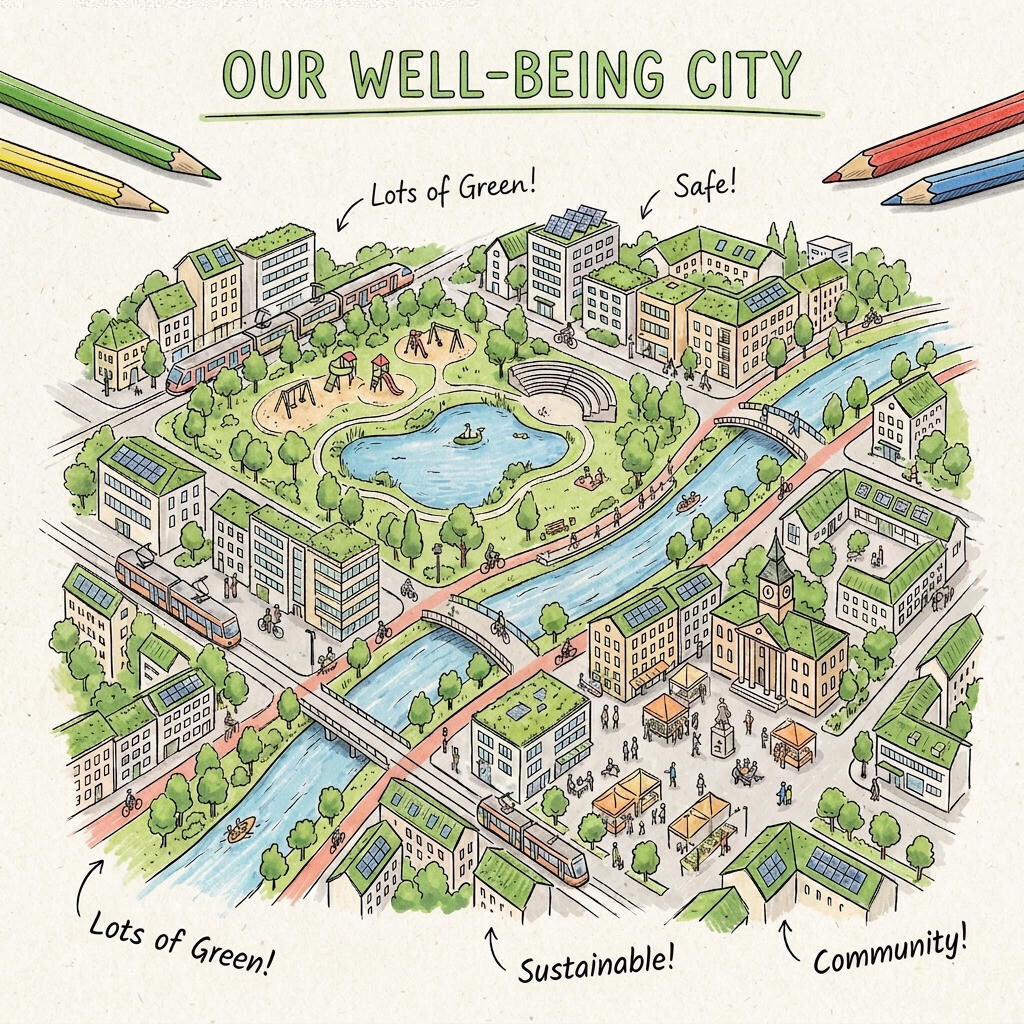
What is a „Well-beeing City“?
Dear students,
Dear teachers,
I’m very happy to be here with you today. As mayor of a city with about 45,000 residents, I grapple with one central question every day: How can we shape our city so that people truly feel at home here?
That’s exactly what I’d like to talk to you about today—the idea of a “well-beeing city.”
1. Well-beeing – what does that aktualley mean?
If I ask you, “Where do you feel good?”
You’ll probably give a wide variety of answers: at home, with friends, at the sports club, at the youth center, at your favorite café, in the park, or maybe just anywhere you feel safe and accepted.
A “well-beeing city” is a city where as many people as possible experience this feeling as often as possible. It’s important to note that feeling good isn’t the same for everyone. A city is good when it’s diverse and offers space for different needs.
2. Foundation: Security and Trust
A city where people feel good starts with something very basic: safety.
People need to feel safe on the streets—both during the day and at night. This includes well-lit walkways, safe routes to school, and effective emergency services, such as the fire department, police, and ambulance services.
But safety is more than that. It’s also about social Security:
- Do I have someone who will help me if I have problems?
- Are there places where young people can go for help?
- Do I feel taken seriously?
A city where trust prevails — between citizens, the administration, and politicians — is a city where people can feel at home.
3. A City for All Generations
A city where people feel at home isn’t just for a specific age group. It’s for children, teens, adults, and older adults.
For you as students, this means, for example:
- good schools
- sports facilities and clubs
- hangout spots for teens
- places where you can try new things, make music, have discussions, or just hang out together
For older adults, feeling at home might mean:
- accessible paths
- good medical care
- places to meet others
- the opportunity to actively participate in city life
A good city brings these generations together instead of separating them.
4. Environment, Climate, and Quality of Life
A very important issue for the future — and especially for your generation — is how we treat the environment and the climate.
A livable city:
- has green spaces, parks, and trees
- protects rivers and nature
- relies on renewable energy
- promotes biking and public transportation
Why is this so important?
Because clean air, less noise, and a healthy environment are directly linked to quality of life. And because we bear responsibility for the future—for you and for the generations that follow you.
5. Living Together and Respect
A city is home to people with different opinions, backgrounds, religions, and ways of life. That can be challenging at times—but above all, it’s a great opportunity.
A city where people feel at home is a city:
- where no one is excluded
- where respect and tolerance are practiced
- where conflicts are resolved peacefully
- where democratic values matter
Democracy doesn’t just happen in the Bundestag. It begins at the local level: in the city council, in community organizations, in schools—and in everyday life.
6. Get involved instead of just watching
Very important: A city where people feel at home isn‚t created by the mayor or city hall allone. It’s created by the people who live there.
Your opinion matters!
Youth participation, student councils, youth municipal councils, or projects where young people can contribute their ideas are incredibly important.
Maybe you’re thinking: What difference can I really make?
The answer is: More than you you think.
Many great ideas for cities come from young people—because you experience the city differently, because you have new perspectives, and because you are the future of this city.
7. The Role of Urban Policy
As mayor, I see my role as listening, balancing different interests, and working together to find solutions. Sometimes this happens quickly; other times, it takes a long time. Not every decision makes everyone happy—but every decision should be fair, transparent, and understandable.
A city where people feel at home needs:
- responsible leadership
- committed citizens
- mutual respect
- and the courage to try new things
8. Closing Thoughts
To wrap up, I’d like to leave you with a question:
Whats do you want your city to look like in 20 or 30 years?
Maybe you’ll still be living here then. Maybe you’ll have moved away—but this city will remain a part of your history.
A “well-beeing city” isn’t a finished product. It’s an ongoing process that every generation contributes to. And I hope that you see yourselves not just as residents, but as co–creators of your city.
Thank you very much for your attention—and perhaps also for your future ideas for our “well-beeing city.”
Translated with https://www.deepl.com/de/translator (free version)